Showing posts with label fashback. Show all posts

Monday, 9 February 2015

Fashback: Jean Paul Gaultier RTW A/W 2006/7

Fog descended and remained for the weekend. And I, for one, was delighted. I love fog. I love how it casts buildings and trees into swimming contrast against a murky white canvas. I feel the witchy vibes. Against the trickle of cold, I want to swathe myself in cloaks and magic beyond the realities of this world.

Which brought to mind Gaultier's RTW A/W 2006/7 show.

Haunting beauty. Less obvious beauty. Familiars, velvet, long, long hair, floating coats and dresses and scarves.

I mean, how much more delightfully witchy could it be? Ugh. And it's RTW. I'd definitely dress like this on the daily if I could. Give me the corsetry, military details, the demure sex-appeal of more left unshown and unsaid. Give me the faux, the brocade, the sheers. One of the best shows of recent years. 


(Images via vogue.co.uk)

Swoon.

Liked this post? Want more?

Follow me here using google friend connect or bloglovin.

Or follow me on tumblr - twitter - facebook.

Monday, 5 January 2015

Fashback - Anne Valerie Hash A/W 2008-9

Life should be dressed in couture. True couture - not that which is "juicy" or attempts to ape the dying art. Perhaps menial tasks would be more difficult but wouldn't it be worth it in the end? Okay, maybe this is a little silly and unrealistic. I mean, you could only wear most couture as it is designed today (even when painstakingly altered to fit and move with your body perfectly) if you were to spend each day seated with little movement. And you'd have to be able to throw down tens of thousands per outfit.

Fashion legend Pierre Cardin has said many things I can't agree with or feel somewhat distasteful towards but he does make a point worth considering, especially given his expertise on the topic and many years of experience. Couture, he tells us, was once a wearable one-of-a-kind luxury but now the word has come to mean something closer to spectacle or costume. While I love my couture show-stopping, it is interesting to note that, at one time, it wasn't synonymous with period dramas on a catwalk or clothes that require special skill to wear them. Couture is now basically an extension of the French tourism board, a way to market the idea of the lifestyle France offers. Fewer houses are able to withstand the financial strain of a couture show as they almost always incur losses. They are an exercise in fancy rather than reality. This doesn't undermine the talent and creativity Couture Week displays but it does put into context how we might look at the clothes, the intended or imagined lives of the garments when designed. With only around 200 buyers in the world and an increasing attitude of creating art over design - Couture means something different today. It has to. These are investments. Installations. Things to be treated as artefacts in museums or to, in fact, be bought by museums.

One couturier, however, managed to continue the tradition that Cardin alluded to up until recently. As an alum of Chanel, the only house to claim to make a profit on their couture shows, it might make sense that Anne Valerie Hash has been the one to wave a flag for couture that's all about dressing chic, elegant women. Her education seems legible in the clothes. Sadly, it was announced that she wouldn't show again this year - further proof that couture sans a big name is a difficult thing to make work financially if not visually. But, rather than dwell on a sad note, I thought I might instead look back on one of her enduringly lovely collections from A/W 2008-9.

A skillful combination of demure and sexy. That Chanel wisdom - balance, no over-styling. Floor-trailing skirts with plunging necklines. Below the knee hems with collar-bones framed enticingly or body-con silhouettes. Shiny fabrics tamed by slinky loose fits. Traditional items given futuristic twists so organic that they seem natural, logical. No costume in sight. Tailoring and dresses. Multiple silhouettes, lengths, necklines. Again tamed - this time by the palette. Neutrals across the board, tying it together, playing it all down. Never overdone. Modern-day armour with suits worthy of kicking ass at work and dresses for the woman wearing the dress - not the other way around. Shoulder-plates, metallic fabrics, curling cut-work. But again with yin to the yang. The billowy Romantic shirts, the blushing nudes, the girlish dresses. The skill here is not only in the show-stopping beauty made of things one could actually wear, of understated things but in the creation of a collection with a complicated tapestry of influences, seemingly incompatible, that is beyond cohesive. Each piece seems the next logical conclusion. It's true artistry. Poetry in clothes. Clothes for poets. For leaders. For any woman lucky and wealthy enough to afford them.


(Images via vogue.co.uk)

Is one couture worth more than the other? Words evolve, meanings change. Couture is no longer what Cardin's generation described it as but in order to survive, things must evolve, non?

What do you think?


Wednesday, 26 March 2014

Fashback: Lover's Eye Miniatures.

© Birmingham Museum of Art.

From February to June of 2012, the Birmingham Museum of Art had an exhibition of one of the largest extant collections of Lover's Eyes in the world - owned by David Skiers, an eye surgeon, and his wife, Nan. At the time, I had never heard of these bizarre yet beautiful objects. It wasn't until September last year, when I was trying to choose an object to write an essay on for college, that I first came across them. Immediately, I was intrigued and just a tad obsessed. The romance, the drama and the physical loveliness of these objects fascinated me. 

Cameo vs. Miniature


Most of you will be familiar with portrait miniatures - sometimes erroneously mistaken for, and called, cameos in the media. Even if you're not consciously aware of it, you'll have seen examples of them before. Miniatures are (generally) small painted portraits on vellum, ivory, copper and cardboard from the 17th to the 19th centuries. They can be mounted on walls, inside boxes or worn as jewellery in various forms and sometimes will have begun life in one format only to have later been converted to another. Funnily enough, many full-size portraits from that period actually show the sitter wearing or holding a portrait miniature.

"Miniature", surprisingly, does not refer to size as most believe. It, instead, comes from the Latin minium, meaning "red lead". Miniature painting developed originally from medieval manuscript production and the images made to illustrate the texts which were miniated in that pigment.

Fitzherbert and George IV.

Lover's Eyes or Eye Miniatures are a particular sub-genre of this genre of portraiture. The term "Lover's Eye" is not a contemporaneous one but was instead later coined by the collector Edith Weber. They were most common through the period c.1790 to 1820 and are said to have been conceived as more discreet love tokens to be passed between the Prince of Wales and his love, Maria Fitzherbert. George III did not approve of the match between his son and a widowed Catholic but they were married secretly and illegally anyway. The eye miniature provided a greater degree of anonymity and discretion by only revealing the eye of the giver while retaining the sentiment of a regular miniature, allowing the pair to express their forbidden love. It is this origin and level of patronage which is said to have made the objects so popular.

This story of origin is contested, however. Eye miniatures are thought to have actually originated in France and are recorded in sitters books of prominent portrait painters in Britain up to two decades before the episode with the Prince of Wales. He may have popularised the miniatures or increased their popularity but he was almost certainly not the first to commission such an object. 

Eye miniature ring  © Birmingham Museum of Art.

The anonymity which derives from merely depicting the eye means that the identity of the sitter in certain Lover's Eyes often remains a mystery today. Some miniatures include inscriptions but these too can be vague and not particularly helpful. People have speculated that the anonymity was employed to allow owners to wear such tokens openly but few portraits (the only remaining visual evidence for how contemporaneous people wore their clothes and accessories) show us figures wearing Lover's Eyes. This is because they were often symbols of extramarital love affairs. In fact, for extra caution, Lover's Eyes were usually worn beneath layers of clothing and not out in the open at all. That they remain a mystery is a testament to their original intentions and purpose. 

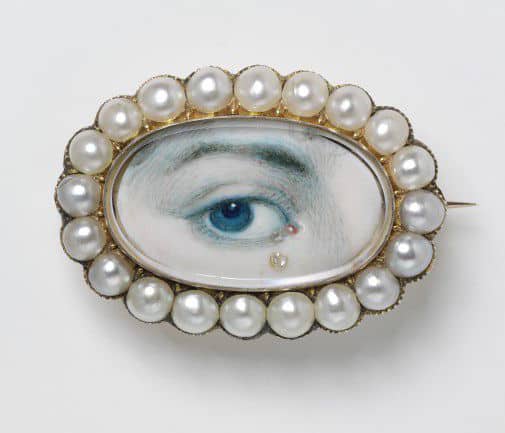
Pearl surrounded miniature with tears © Victoria and Albert Museum.

Later, eye miniatures became popular as a method of remembrance rather than secret love and were painted with tears or peering through clouds. Through Queen Victoria's fondness for them, the miniatures survived (though with much lesser popularity) just into the twentieth century and there are still some artists making them today. 

Hair work at the back of a miniature. 19th Century Mourning Brooch, Case Antiques.

Lover's Eyes, like all miniatures, are highly intimate objects. Generally small and either worn as jewellery or contained in boxes carried on the person, they encouraged one-on-one interaction. Hair work (making images, generally on the back, out of the hair of the sitter or just the inclusion of some hair) was also a common element, adding to the physicality and intimacy by allowing a lover to carry a small part of their beloved around with them. But eye miniatures were particularly intimate, as they required the physical familiarity between individuals to recognise another by merely their eye and without context. The intended recipient would have had a very different experience of viewing an eye miniature to anyone else now or when it was created.

It is estimated that only around a thousand Lover's Eyes exist today and eye miniatures have become highly sought-after objects with replicas and reproductions having become very popular. Though they may have long since fallen out of popular favour, there are those of us who continue to be suckered in by the romance and loveliness of the objects.

Eye miniature in pearl surround with clouds. © Birmingham Museum of Art.

I was telling a friend about this piece and Lover's Eyes the other day and she thought there something creepy about them. I can understand how they might seem like odd little objects to a modern audience. Especially because of the inclusion of hair work. However, how far is this really from parents keeping baby teeth or locks of hair today? Not so far, I think. The focus on the eye in isolation of the rest of the body, too, which I would argue has become something unsettling largely through its use on horror movie posters, lends an atmosphere of discomfort to some modern viewers. For me, it's easy to look past these aspects (even though I'm weird about eyes) and just see the romance. The intimacy and familiarity they imply as well as the ceremony of wearing and carrying around jewellery or mementos to keep a loved one in mind (especially when they actually contain a little part of that person) is beautiful to me. I would totally rock one of these.

How about you guys? What do you make of Lover's Eye miniatures?